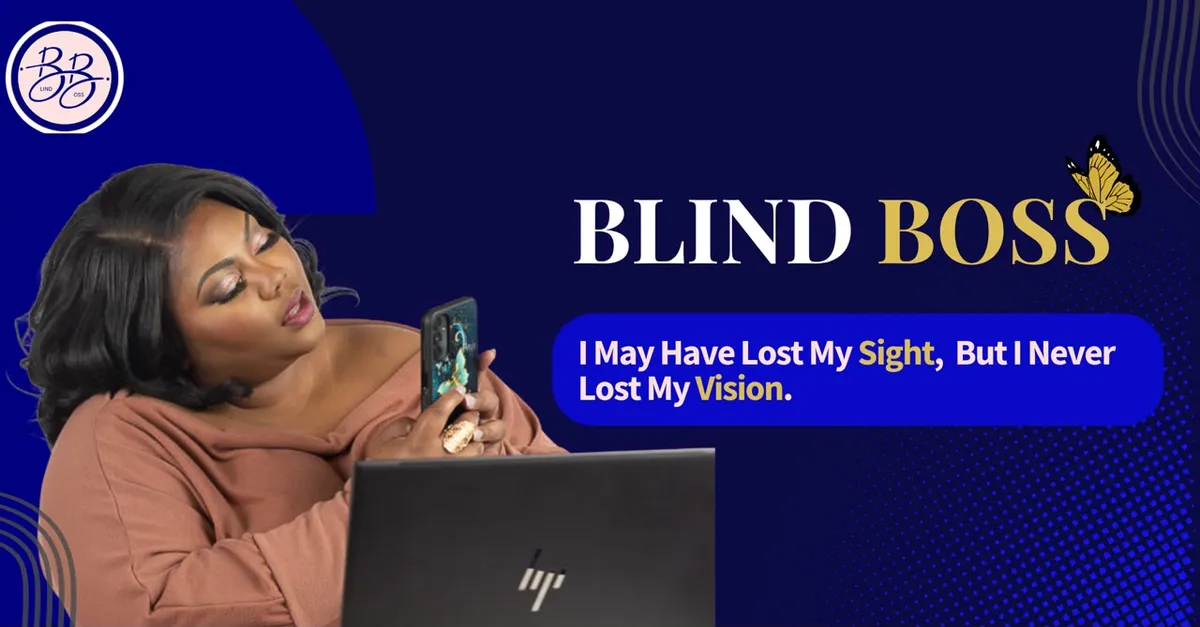
The Blind Boss Ten Commandments
The Blind Boss Ten Commandments
If you've ever wanted to hand somebody a little rulebook before they interact with you, welcome to my world.
Being a blind entrepreneur has taught me a lot about business, boundaries, and the astonishing confidence people have when telling somebody else what they can and cannot do.
So I've decided to share my Blind Boss Ten Commandments. And yes, we're doing “thou shalt,” because some lessons deserve to sound like they were carved into stone.
These apply whether you're disabled, work with someone who is, or simply need a reminder to mind your business while respecting somebody else's.
1. Thou shalt not confuse disability with incompetence.
My eyesight has changed; my intelligence, experience, and ability to build campaigns did not disappear with it.
I once interviewed for a W-2 role at an organization that had already hired me successfully as a contractor years earlier. Back then, they trusted me to deliver.
When I returned with significantly less vision—but more professional experience—I went through interview after interview and still felt I had to prove skills they'd already seen.
They were excited about my campaign-building abilities, then hesitant to let me actually build campaigns. Make it make sense.
2. Thou shalt speak to the person, not around them.
Whether I'm in a meeting, at an event, or working with a client, talk to me about my own work and decisions.
My assistant, husband, or whoever is nearby isn't automatically my spokesperson. I'm right here, and I have opinions. Quite a few, actually.
3. Thou shalt ask before offering help—and wait for the answer.
Please don't grab me and start walking because you've decided where I'm going. You might be taking me in the exact opposite direction.
That applies to business coaching, too: don't grab the metaphorical steering wheel and decide what success should look like for your client without asking where they're trying to go.
4. Thou shalt not treat accessibility as a luxury upgrade.
Accessible documents, tools, meetings, and workflows help people contribute their expertise.
They're not party favors, and asking for them isn't asking for special treatment. A qualified person should have a fair opportunity to do the work.
5. Thou shalt remember that disability is not one-size-fits-all.
Two people with similar diagnoses may have different abilities, needs, and preferences. Ask what works instead of assuming. It's the same reason I customize implementation strategies for my clients rather than handing everyone the same pretty template and hoping for the best.
6. Thou shalt respect the systems that support success.
Assistive technology, AI, delegation, and a good team are tools, not evidence that somebody is less capable.
We don't tell a CEO they're cheating because they hired an accountant. Why should it be different when a blind CEO uses the support that helps her lead?
7. Thou shalt not make my disability my entire personality.
I'm a business owner, strategist, wife, mom, and a whole human being. Blindness affects my life, but it is not the only interesting thing about me. I promise I have more to talk about than my eyeballs.
8. Thou shalt let me decide what counts as my big accomplishment.
People sometimes act like I deserve a parade for crossing the street or finding the bathroom.
Those skills can take work, and I'm proud of my progress—but I get to decide when we break out the confetti.
You may be celebrating that I found the meeting room while I'm over here thinking about the contract I'm about to close. Both things can matter without you deciding which one is the headline.
9. Thou shalt not measure thy journey with somebody else's ruler.
I've had coaches and other people try to prescribe a version of success that didn't match my actual life, business, or goals.
Learn from other people's strategies, sure. But their definition of winning doesn't have to be yours. I don't need to arrive at your destination just because you know the route.
10. Thou shalt advocate for thyself and guard thy boundaries.
One of my biggest lessons has been refusing to let other people's perceptions of me become my perception of myself.
Therapy reminded me that I cannot control other people's thoughts or reactions. I can control how much power I give those reactions. I know my skills, I know my worth, and I can keep learning. “No” is a complete sentence, even when somebody would really prefer a PowerPoint explaining it.
BONUS COMMANDMENT: Thou shalt not call my white cane a stick.
It is a CANE. A white cane. Not a stick. Please, for the love of all things accessible, let's get that one right. LOL.
Here's what I want you to do before the new year: write your own ten commandments. What will you do? What will you no longer tolerate? What standards will guide the way you work, lead, and let others treat you? Put the list somewhere you'll encounter it regularly, so when a situation gets emotional you won't have to invent your boundaries on the spot. You'll already know what you decided. And remember, you don't have to wait for someone else to believe in your capabilities before you act like you believe in them yourself.
